Guide
How tile edges are finished: trims and mitres
A tile trim is a metal or PVC strip set under the last tile to protect and finish its edge on outside corners, window reveals and the top of half-height tiling. PVC and aluminium are the everyday choices; stainless steel suits floors and wet areas, and brass is chosen for its look. A mitred edge is the trim-free alternative.
Updated
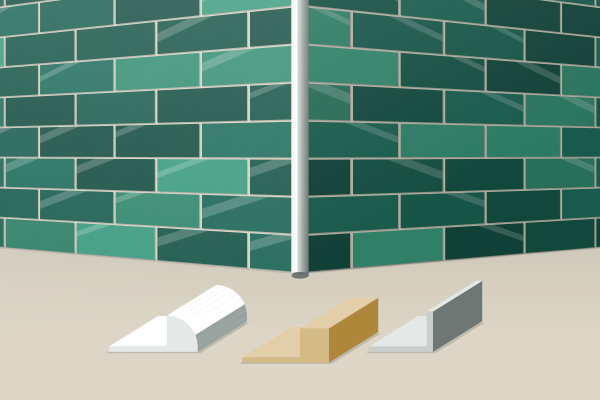
What a tile trim does
A trim is an L-shaped strip. One leg is perforated and sits in the adhesive under the last tile; the other forms a finished edge level with the tile face. It covers the cut or unglazed edge, guards an outside corner against chips, and gives a straight line to finish against. Trims go on outside corners, round window reveals and boxing, along the top of half-height tiling, round a shower niche, and where a tiled floor meets another floor. Each comes in heights to suit the tile thickness.
Materials: PVC, aluminium, stainless steel and brass
PVC is the cheapest and easiest to cut, comes in many colours to match grout or tile, and suits walls in light use. It can yellow or dent over the years.
Aluminium comes in natural, brushed, chrome-effect, black and coloured finishes, and is the everyday metal choice for walls. A chrome or black tile trim is usually anodised or coated aluminium.
Stainless steel wears harder and resists corrosion, so it suits floors, pools, commercial kitchens and wet areas where aluminium may corrode. It costs more and is harder to cut.
Brass, solid or brass-effect, is chosen for its look, often with brushed brass taps. Solid brass tarnishes unless lacquered; brass-effect trims are coated aluminium.
Ceramic edging, such as pencil and bullnose tiles, is a different route: tiles made with a finished rounded edge to match a range.

Profiles: round edge, square edge and angle
Round edge, often called quadrant, curves over the tile edge and gives the softest look; it is common in bathrooms. Square edge, also sold as box or straight edge, gives a crisp line that suits large porcelain and metro tiles. Angle trims are a plain L that shows only a thin strip on the face, the closest look to a bare edge. There are also profiles for particular jobs: stair nosings, transitions between tile and another floor, and movement joint profiles that let a large floor move at a joint.
Trim or mitred edge?
A mitre is two tile edges cut at 45 degrees on a wet saw and meeting at the corner, so the tile seems to wrap round it with no strip showing. It looks sharp on stone and on porcelain whose colour runs through the body. It takes longer, needs accurate cutting and leaves a more fragile corner, so tilers often ease the edge slightly. Glazed ceramic with a contrasting body shows a line at the mitre and usually gets a trim. On busy corners that get knocked, a trim protects better. Ask which you are getting before work starts, because the two look different and are priced differently.
Choosing and fitting trims
Match the trim to the tile thickness, not the tile size, and buy it with the tiles so the finish suits the taps, shower screen or grout. Several makers sell trims; one, Schlüter, is so widely used that its name is often used for metal trims in general. A tiler fits trims as the tiles go on, because the trim's leg sits in the adhesive, so they cannot be added neatly to a finished wall.
Common questions
What is a tile trim?
A metal or PVC edging strip fixed under the last row of tiles to cover and protect the tile edge at corners and the ends of tiled areas.
What tile trim should I use in a bathroom?
Aluminium or PVC suits most bathroom walls; stainless steel suits floors and wet areas that take heavy cleaning. Pick the finish to match the taps and the profile to suit the tile.
What is the difference between round edge and square edge trim?
A round edge trim curves over the tile edge for a soft finish. A square edge trim gives a sharp right-angled line that suits modern and large tiles.
Do you need tile trim on every edge?
No. Edges that meet a wall, ceiling or worktop are cut and sealed. Trims or mitres are for exposed edges and outside corners.
What size tile trim do I need?
The trim height should match the tile's thickness so its edge sits flush with the tile face. The tile maker's data sheet gives the thickness.