Service
Large format tiling
Large format tiling averages £250 a day in Checkatrade's 2026 large format guide, with labour at the higher end of about £50 per m² because big tiles are slower to cut and lay. The same guide says a tiler lays 10 to 15 m² of large tiles a day. A flat base and a second pair of hands decide the result.
What this covers
What it costs. Prices per square metre and per job, and what moves them, are in the cost guide. Full cost breakdown.
Typical jobs
- 120 by 60 cm porcelain through an open-plan kitchen and living area
- Large porcelain on a bathroom wall with few grout lines
- Levelling a floor to tolerance before laying large tiles
- Using a levelling clip system to keep large tile edges flush
- Thin porcelain slabs on a shower wall in place of small tiles
What is involved
Large format usually means tiles with a side of 60 cm or more, up to porcelain slabs taller than a person. Fewer grout lines make a room look calm, but every fault in the base shows. A 1.2 m tile cannot bend into a dip, so a floor that is fine for 30 cm tiles may need levelling first, and a wall may need lining. Tilers check flatness with a long straight edge before quoting, and a floor that fails is put right with a levelling compound before any tile goes down.
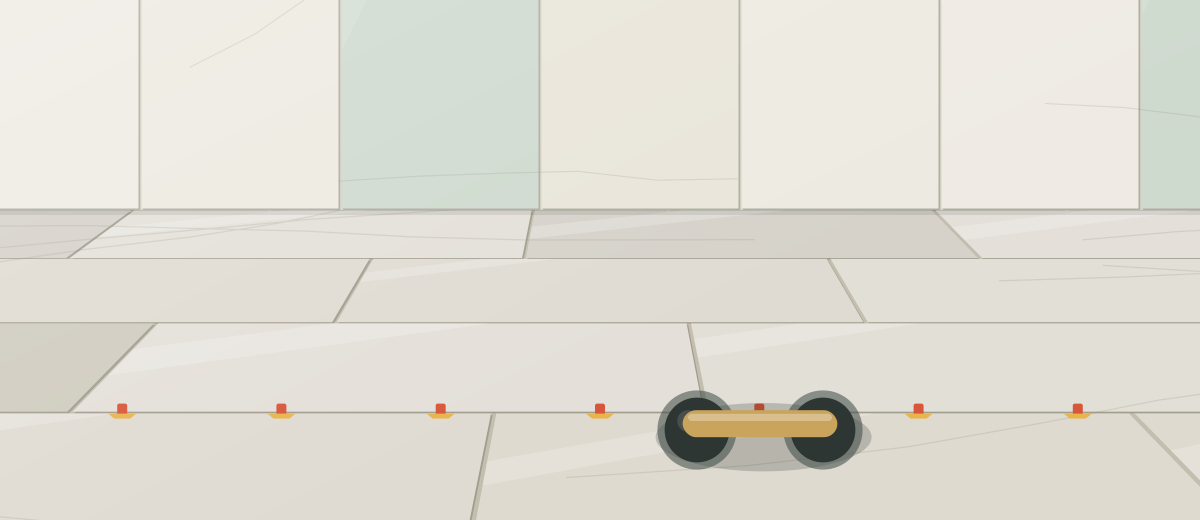
Big tiles are bedded in a full layer of adhesive with no voids. The tiler combs adhesive onto the floor and also spreads a thin layer on the back of each tile, called back-buttering, then beats the tile down. Levelling clip systems hold neighbouring edges flush while the adhesive sets. Long rectangular tiles are slightly bowed from firing, so they are usually laid with an offset of no more than a third of their length, unless the tile maker allows more, or the edges will not sit level. Tiles above about 60 cm are usually handled by two people, and the largest slabs need suction lifters and a frame.
Weight is the other limit. On a wall, a large porcelain tile plus adhesive can pass the 20 kg per m² that BS 5385-1 allows on a gypsum plaster finish, so the wall may need a stronger background. Large floors need movement joints, at the edges and within big areas, and the joint layout should be planned with the tile layout so joints fall on grout lines. Cutting waste can be higher too, since one wrong cut costs a whole tile.
Choosing someone for the job
Large tiles leave no room for a poor base, so the questions are mostly about preparation and handling.
- How will you check the floor or wall is flat enough, and what if it is not?
- Do you back-butter every tile and use a levelling clip system?
- Is this a two-person job, and is the second person in the price?
- What offset for rectangular tiles, and where will the movement joints go?
- How much extra tile should I order?
Read next
Common questions
What counts as a large format tile?
Usually any tile with a side of 60 cm or more, from 60 by 60 cm up to porcelain slabs over a metre long.
Do large tiles need a perfectly flat floor?
Close to it. A large tile cannot follow a dip, so it rocks or leaves an edge standing proud. Floors are checked with a long straight edge and levelled first if needed.
What is back-buttering?
Spreading a thin layer of adhesive on the back of each tile as well as combing it onto the floor or wall, so there are no hollows under the tile.